The industry's defining report arrived. Here is what it confirms — and how Rack Centre is positioned for it.
The 2026 Data Centres in Africa Economic Report, published by the Africa Data Centres Association, is the most comprehensive picture yet of where the continent’s digital infrastructure stands, and how far it still needs to go.
Rack Centre is cited within its pages as a case study in sustainable, AI-ready infrastructure. But beyond the mention, what resonated most was how precisely the report’s diagnosis maps to the problem we set out to solve in the West African region.
This is our perspective on what the findings mean, for West African businesses, and for the infrastructure being built to serve them.
The Compute Gap Is Still Wide
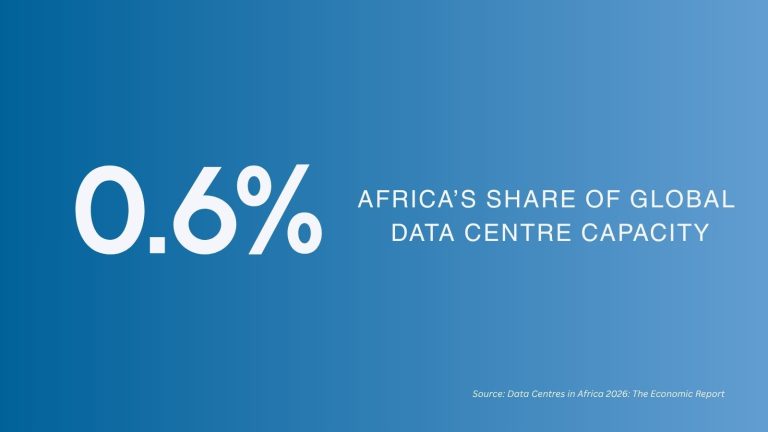
Africa is home to nearly one in five people on earth. Yet the continent accounts for just 0.6% of global data centre capacity. While global investment in digital infrastructure is projected to reach $3 trillion over the next five years, Africa’s share remains a fraction of what its population and economic potential demand.
The consequences are not abstract. When African businesses run cloud applications, process payments, or deploy AI tools, that data is frequently travelling thousands of kilometres to a server in Europe or North America before returning. Every millisecond of that journey costs time, money, and competitive ground.
When data is hosted offshore, value flows offshore. African businesses pay more for slower, less reliable services - and the opportunity to build AI on African data, for African needs, slips away.
Nigeria sits at the heart of this challenge. As one of the continent’s four primary data centre hubs, alongside South Africa, Egypt and Kenya, it carries outsized responsibility for shaping West Africa’s digital future. That is the context in which Rack Centre operates every day.
Power Is The Defining Variable - And We Treat It That Way
Perhaps the report’s most striking insight is its reframing of the infrastructure challenge. For years, the conversation centred on connectivity – fibre, bandwidth, subsea cables. The 2026 report is direct: in Africa, power is now the primary constraint on data centre growth.
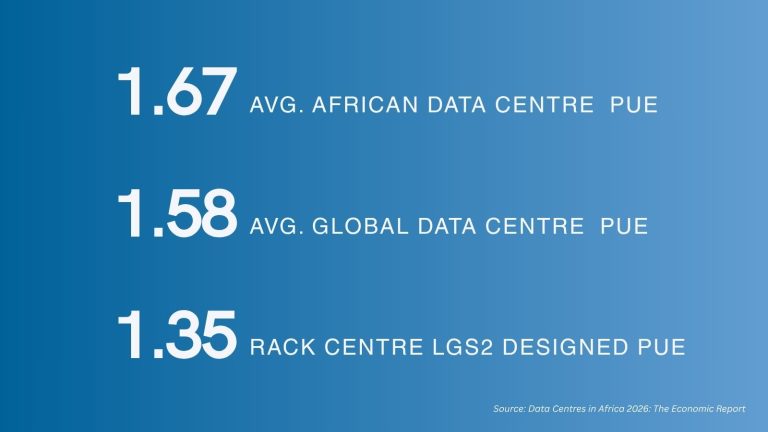
Grid instability in markets like Nigeria forces operators to function as de facto independent power plants. The report notes that this ‘instability tax’ contributes to an average African Power Usage Effectiveness (PUE) ratio of 1.67, well above the global benchmark of 1.58, eroding the cost-competitiveness of local hosting.
At Rack Centre, we have not waited for the grid to improve. Our LGS2 facility represents a fundamental redesign of how energy is generated, managed and consumed within a mission-critical environment. By transitioning away from diesel-dependent models toward a gas-fired captive power solution, complemented by a modular solar installation, we have built a facility that delivers reliability without compromising on environmental performance.
The results speak directly to what the report calls for:
- 1.35 PUE – the lowest currently operating in the regional market
- 21.5% annual emissions reduction through the shift to cleaner gas-based power
- Solar designed to cover 5.5% of long-term 12MW capacity, currently offsetting 43% of Phase 1 operational load
The report argues that data centres must evolve into anchor investors in national energy security. We are already living that model.
Connectivity Ecosystems Are The New Moats.
The report introduces a critical concept: the “Compute Divide.” Even as fiber optic networks expand to 1.3 million kilometers across the continent, the real bottleneck is no longer just the cable in the ground, it is the distance between the user and the data. In West Africa, we are closing this divide through Interconnect Density. The report notes that “Connectivity Hubs”, facilities that prioritize hosting Internet Exchange Points (IXPs) and subsea cable landing stations, are becoming the central nodes of the regional network.
At Rack Centre, we’ve built exactly that:
- The Gateway to the World: Direct, unrestricted access to all 8 undersea cables serving the West African Coast, including Equiano and 2Africa.
- A Neutral Meeting Place: With 73+ carriers, ISPs, and content networks, we operate West Africa’s most connected carrier-neutral hub.
Localizing the Internet: By hosting the leading IXPs (IXPN & AF-CIX), we ensure that local traffic stays local, slashing latency and accelerating digital performance in the region.
Markets with local data centres consistently record materially lower and more stable latency.
Our carrier-neutral ecosystem means businesses aren’t locked into one provider; they have the flexibility to switch, negotiate, and scale at the speed of their own ambition.
AI-readiness Is a Present Requirement.
The report documents a fundamental hardware shift reshaping global data centres: the move from CPU-based storage to GPU-powered AI processing. A standard enterprise server rack draws between 5kW and 15kW. A rack populated with modern AI GPUs can demand between 60kW and 120kW, an eight-fold increase that renders traditional facility designs obsolete.
For Rack Centre, AI-readiness extends beyond cooling specifications and rack design. It encompasses a broader commitment to building infrastructure that supports innovation while advancing Africa’s energy transition. LGS2 was conceived with this shift in mind, high-density compute infrastructure with sustainability embedded at its core, not retrofitted as an afterthought.
Success will not be measured by who built the most capacity first, but by who built the most adaptable infrastructure to host the intelligence of tomorrow.
The report notes that most African operators are currently adopting a pragmatic ‘ready-when-needed’ approach, modular AI-provisioned designs that allow GPU capacity to scale as demand materialises. This mirrors our own philosophy. Infrastructure built for tomorrow’s workloads, delivered with the reliability standards that today’s enterprises require.
Data Sovereignty Is a Business Decision.
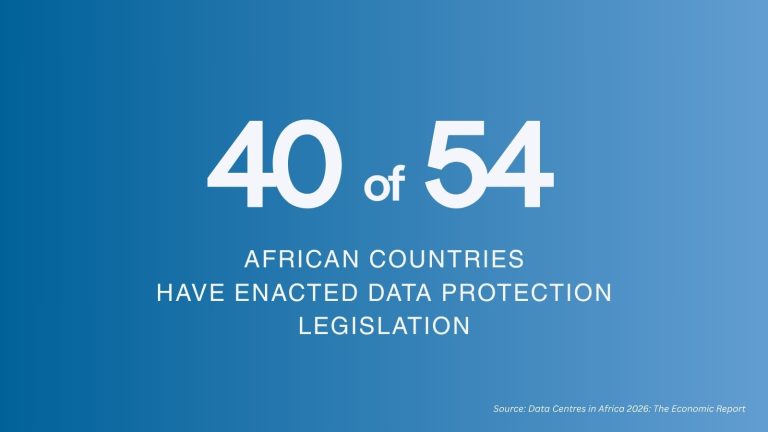
More than 40 African countries have enacted data protection legislation. The report is clear that regulatory clarity is becoming a decisive factor in where cloud and colocation operators site their facilities. Stronger, more predictable regulation is increasingly seen by investors as a prerequisite for scaling local digital infrastructure.
For enterprises operating in Nigeria, this matters in practical terms. Data hosted locally means faster performance, reduced foreign exchange exposure on data egress fees, simplified compliance with Nigerian data protection frameworks, and greater operational resilience.
The report frames data sovereignty not just as a regulatory obligation but as a foundation for value creation. When data generated in Africa is processed abroad, the continent loses the economic value and the opportunity to build its own digital intelligence. Rack Centre exists to keep that value here.
The Talent Opportunity Is One We Take Seriously
One of the report’s more human insights concerns the engineers who keep African data centres running. Maintaining 99.99% uptime in Lagos requires navigating systemic grid volatility that operators in mature markets rarely encounter. The report notes that this environment has cultivated a workforce with a unique aptitude for resilient systems management, making African engineers high-value candidates on the global stage.
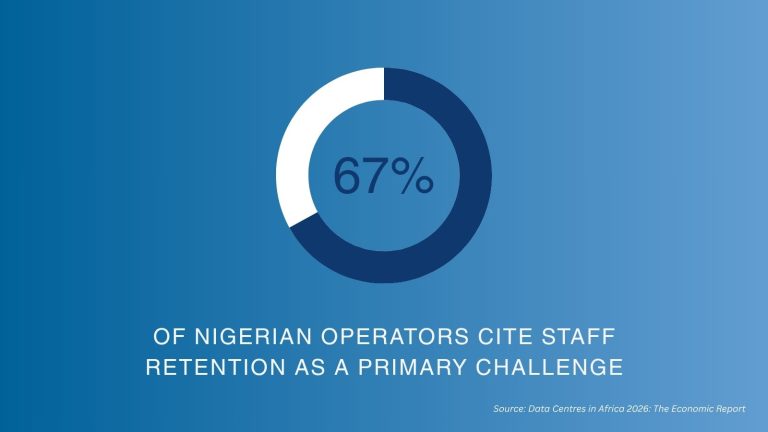
The challenge is brain drain. The report cites an ADCA survey finding that 67% of operators in Nigeria cite the retention of skilled staff as their primary HR challenge. At Rack Centre, we view talent development not as a cost but as a strategic investment — in our operations, and in the broader Nigerian digital economy.
Where We Go From Here
The 2026 Data Centres in Africa report is, at its core, an argument that the moment is now. The infrastructure gap is real, but it is closing. The investment is arriving. The regulatory environment is maturing. And the demand, driven by AI, cloud adoption, and the digitisation of African enterprises, is building toward an inflection point.
At Rack Centre, we have been building for this moment for years. Not because a report told us to, but because the need has always been clear to anyone paying attention to Nigeria’s digital trajectory.
The report calls for modern, scalable, sustainable facilities designed with future demand in mind. We believe LGS2 is exactly that. And we are not done building.
West Africa's digital backbone is being built. The question is not whether the infrastructure will exist, it is whether Nigerian businesses will be ready to use it.